


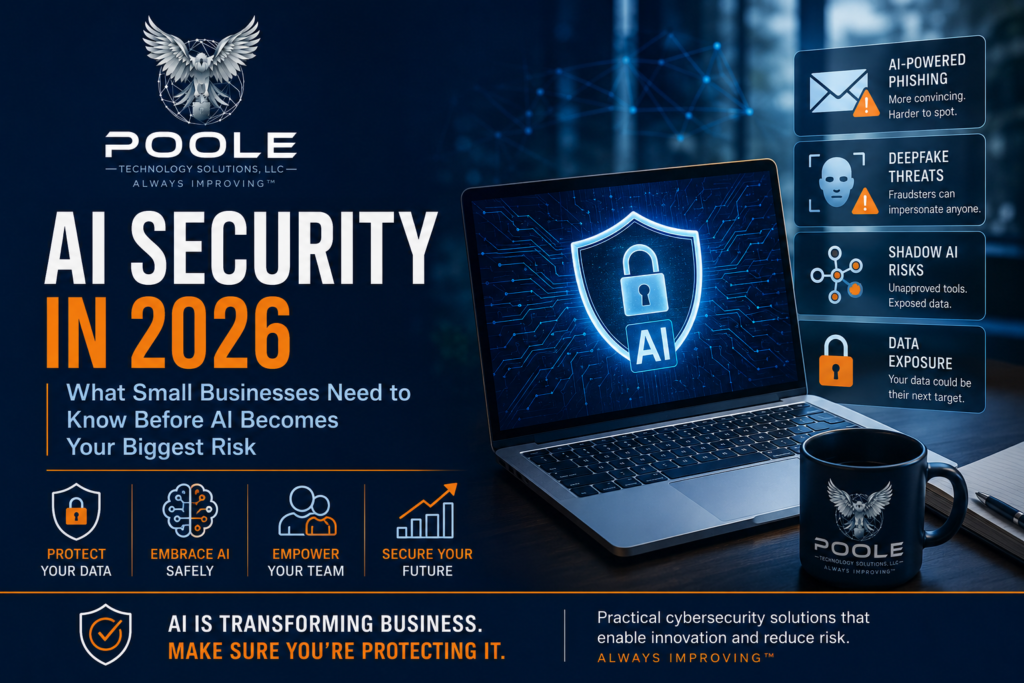
Artificial intelligence is rapidly becoming a business necessity. Employees are using AI to summarize meetings, draft emails, analyze data, create presentations, and automate workflows. Businesses that embrace AI can increase productivity and reduce operational costs.
But there is another side to this transformation.
Cybercriminals are now using AI to automate phishing campaigns, create deepfake scams, build malware faster, and scale attacks at a speed that smaller organizations struggle to defend against. Recent research indicates AI is now a routine component of cyber attacks, while organizations increasingly recognize AI as a major cyber risk driver.
Why SMBs Are Increasingly Targeted
Small businesses often believe attackers focus only on large enterprises.
That assumption creates risk.
Many SMBs have:
• Smaller IT teams
• Limited cybersecurity budgets
• Faster technology adoption cycles
• Fewer security controls around new AI tools
Attackers recognize this opportunity and increasingly automate attacks to scale operations against organizations with fewer resources. AI allows attackers to personalize phishing emails, automate reconnaissance, and improve success rates with less effort.
AI Powered Phishing Is Becoming More Convincing
One of the biggest shifts SMBs face is the rise of AI enhanced phishing.
The recent emergence of phishing services such as Kali365 demonstrates how attackers are using AI generated lures and token theft techniques to compromise business accounts, including cloud collaboration platforms. These attacks target legitimate authentication processes rather than passwords alone.
Employees should expect:
• More realistic emails
• Fewer spelling mistakes
• Personalized messages
• Voice cloning attempts
• Deepfake video impersonation
• Highly targeted business email compromise attacks
Shadow AI Creates Hidden Business Risks
Many employees are already using AI tools without organizational oversight.
This creates several risks:
• Sensitive company information being uploaded to public AI tools
• Loss of customer data confidentiality
• Intellectual property exposure
• Regulatory concerns
• Unapproved third party AI vendors
AI adoption without governance creates business risk long before organizations realize data exposure has occurred.
Attack Timelines Are Shrinking
Security teams traditionally had weeks or months to react to emerging threats.
AI is changing that.matically decreased as AI accelerates vulnerability discovery and attack developm
Industry reporting suggests vulnerability exploitation timelines have draent. Organizations may have less time than ever to patch and respond.
For SMBs, speed now matters as much as prevention.
Five Practical Security Actions SMBs Should Take Today
1. Create an AI Usage Policy
Define:
• Approved AI tools
• Restricted data types
• Acceptable business use cases
• Approval processes for new tools
2. Strengthen Identity Security
Focus on:
• Multi factor authentication
• Conditional access policies
• Password managers
• Identity monitoring
3. Train Employees on AI Driven Threats
Security awareness training should now include:
• Deepfakes
• AI phishing
• Voice impersonation
• Verification procedures
4. Monitor Third Party AI Vendors
Ask vendors:
• How data is stored
• Whether prompts are retained
• Encryption standards
• Security certifications
5. Build AI Governance Early
You do not need an enterprise program.
You need ownership.
Assign accountability for:
• AI tool approvals
• Risk reviews
• Vendor evaluations
• Incident response
Final Thoughts
AI is not the enemy.
Uncontrolled AI adoption is.
Organizations that adopt AI while building practical governance, security controls, and employee awareness will gain the productivity benefits while reducing unnecessary risk.
At Poole Technology Solutions, we believe cybersecurity should enable innovation, not prevent it.
Always Improving.
Key Takeaways:
• AI adoption is increasing organizational risk exposure
• AI phishing and deepfake threats are becoming more sophisticated
• Shadow AI creates hidden data security challenges
• Identity security matters more than ever
• Governance and awareness are critical for SMB success
Call To Action:
Is your business adopting AI faster than your security program can support it?
Poole Technology Solutions helps organizations reduce risk while enabling innovation through practical cybersecurity guidance and security strategy.
Businesses interested in evaluating their security posture can begin with the Cybersecurity Readiness Assessment provided by Poole Technology Solutions: