


Introduction
Many small business owners believe cybersecurity begins with purchasing antivirus software, firewalls, or the latest security platform. While these technologies are important, they are only as effective as the strategy guiding them.
Every year, organizations invest thousands of dollars in security products while overlooking the governance processes that determine whether those tools are configured correctly, monitored consistently, and aligned with business objectives.
Cybersecurity governance provides the structure that transforms isolated security tools into a coordinated security program. It helps organizations make informed decisions about risk, establish accountability, develop policies, and continually improve their security posture.
For small businesses, governance is not about creating unnecessary bureaucracy. It is about protecting the business, safeguarding customer trust, supporting regulatory compliance, and ensuring security investments deliver measurable value.
What Is Cybersecurity Governance?
Cybersecurity governance is the framework of leadership, policies, processes, and oversight that guides how an organization manages cybersecurity risk.
Rather than focusing solely on technical controls, governance answers important business questions such as:
- What information are we protecting?
- Which risks pose the greatest threat to our business?
- Who is responsible for cybersecurity decisions?
- How much risk is acceptable?
- Are we meeting industry regulations?
- How will we respond if an incident occurs?
Governance aligns cybersecurity with business objectives so that security becomes part of everyday operations instead of an afterthought.
Why Small Businesses Often Overlook Governance
Many SMBs operate with limited staff and resources. Business owners often wear multiple hats and understandably prioritize revenue generation, customer service, and day to day operations.
As a result, cybersecurity frequently becomes reactive.
Common scenarios include:
“We’ll address security after we grow.”
“We already have Microsoft 365.”
“Our managed service provider handles security.”
“We’ve never experienced a breach.”
Unfortunately, cybercriminals frequently target smaller organizations because they often lack mature security programs while still maintaining valuable customer data, financial information, and business systems.
Without governance, organizations often experience:
- Inconsistent security practices
- Undefined responsibilities
- Weak vendor oversight
- Poor visibility into cyber risks
- Delayed incident response
- Increased compliance challenges
Governance Is More Than Technology
Cybersecurity products reduce risk.
Governance manages risk.
Organizations often purchase:
- Endpoint protection
- Firewalls
- Email security
- Multi-factor authentication
- Backup solutions
While these technologies are essential, governance determines:
- Which technologies are required
- How they should be configured
- Who manages them
- How success is measured
- When risks are reviewed
- How security decisions support business goals
Technology without governance often results in unnecessary spending, inconsistent implementation, and security gaps.
Five Governance Practices Every Small Business Should Implement
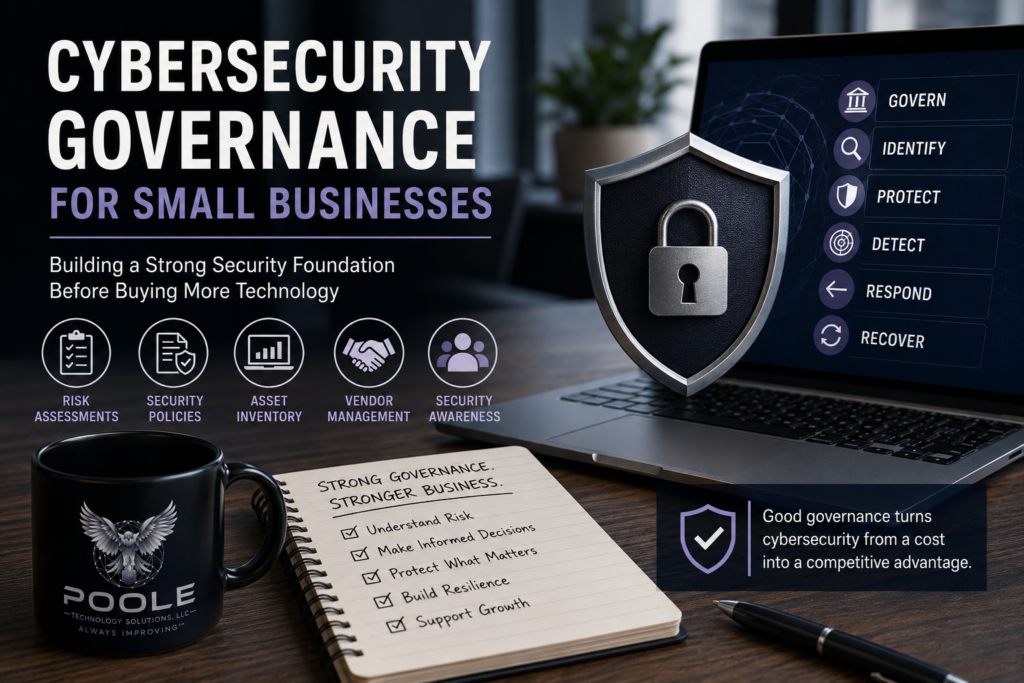
1. Conduct Regular Cybersecurity Risk Assessments
You cannot protect assets you have not identified.
A cybersecurity risk assessment provides visibility into:
- Critical business systems
- Sensitive information
- Existing vulnerabilities
- Threat likelihood
- Business impact
- Risk prioritization
Rather than attempting to fix everything simultaneously, organizations can focus resources on the risks that matter most.
2. Establish Written Security Policies
Policies establish expectations throughout the organization.
Every small business should maintain policies covering areas such as:
- Password management
- Multi-factor authentication
- Acceptable use
- Remote work
- Mobile devices
- Vendor management
- Data classification
- Incident response
- Business continuity
- Security awareness
Policies create consistency while supporting compliance requirements and cybersecurity insurance expectations.
3. Maintain an Accurate Asset Inventory
You cannot secure systems you do not know exist.
An inventory should include:
- Computers
- Servers
- Cloud services
- Mobile devices
- Software
- Email domains
- Third-party applications
- Administrative accounts
- Critical business data
An accurate inventory serves as the foundation for vulnerability management, patch management, and incident response.
4. Manage Third-Party Vendor Risk
Modern businesses depend heavily on external vendors.
Examples include:
- Payroll providers
- Website developers
- Cloud applications
- Payment processors
- Marketing platforms
- Managed service providers
- Accounting software
Each vendor introduces potential cybersecurity risk.
Businesses should evaluate vendors by considering:
- Security certifications
- MFA support
- Encryption practices
- Incident response procedures
- Regulatory compliance
- Data retention policies
Vendor risk management protects not only your organization but also your customers and partners.
5. Build a Security-Aware Culture
Technology cannot stop every cyberattack.
Employees remain the first line of defense.
Security awareness should include ongoing education about:
- Phishing
- Business Email Compromise (BEC)
- Social engineering
- Password hygiene
- AI-enabled scams
- Data handling
- Physical security
Organizations that invest in employee awareness significantly reduce the likelihood of successful attacks.
Using NIST Cybersecurity Framework 2.0 as a Roadmap
Many business owners believe cybersecurity frameworks are only designed for large enterprises.
The NIST Cybersecurity Framework (CSF) 2.0 demonstrates otherwise.
Its six core functions provide organizations of all sizes with a practical roadmap for managing cybersecurity risk.
Govern
Establish leadership, accountability, policies, and oversight.
Identify
Understand assets, systems, data, and business risks.
Protect
Implement safeguards that reduce the likelihood of compromise.
Detect
Monitor systems to identify suspicious activity quickly.
Respond
Prepare to contain and manage cybersecurity incidents.
Recover
Restore business operations while strengthening resilience against future events.
Organizations do not need to implement every recommendation overnight. Instead, the framework encourages continuous improvement based on organizational size, resources, and risk tolerance.
Common Governance Mistakes
Many organizations unintentionally create unnecessary cybersecurity risk by:
- Believing cybersecurity is solely an IT responsibility
- Purchasing technology before understanding business risks
- Neglecting regular risk assessments
- Failing to review vendor security practices
- Allowing excessive administrative privileges
- Operating without documented policies
- Providing limited employee security training
- Treating compliance as the finish line rather than an ongoing process
Governance helps organizations avoid these pitfalls by establishing repeatable processes that support informed decision making.
How Poole Technology Solutions Helps
At Poole Technology Solutions, we understand that small businesses rarely have dedicated cybersecurity departments or enterprise sized budgets.
Our goal is to help organizations build practical, scalable cybersecurity programs that align with business objectives while meeting regulatory and industry expectations.
Our services include:
- Cybersecurity Risk Assessments
- Cybersecurity Governance Consulting
- Security Policy Development
- Email Security and Authentication (SPF, DKIM, DMARC)
- Security Awareness Training
- Compliance Readiness
- Business Continuity Planning
- Third-Party Risk Reviews
- Security Program Maturity Assessments
We focus on helping organizations prioritize the most significant risks first, allowing them to improve security without unnecessary complexity.
Conclusion
Cybersecurity is no longer defined by the number of security products an organization owns.
True resilience begins with governance.
By establishing clear policies, understanding business risks, maintaining visibility into critical assets, educating employees, and following recognized frameworks such as NIST CSF 2.0, small businesses can build a sustainable cybersecurity program that supports long-term growth and protects what matters most.
Technology will continue to evolve. Threats will continue to change.
Organizations built on strong cybersecurity governance will be better positioned to adapt, respond, and thrive.
Call to Action
Is your organization building its cybersecurity program on a solid foundation?
Poole Technology Solutions helps small businesses and nonprofit organizations identify risks, strengthen governance, improve compliance, and implement practical security solutions tailored to their unique needs.
Contact us today to schedule a Cybersecurity Readiness Assessment and discover how a governance-first approach can help protect your business, your customers, and your reputation.
Email: info@pooletechsol.com
Website: www.pooletechsol.com