


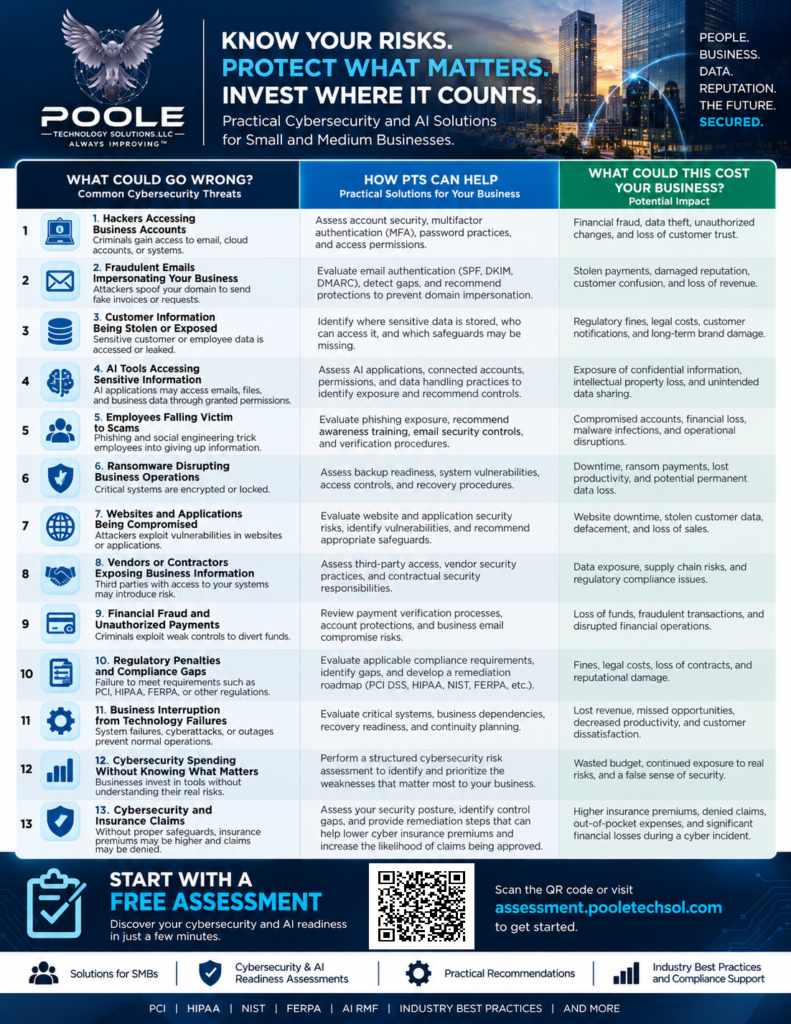
Why Small and Medium Businesses Must Take a Proactive Approach to Cybersecurity, AI Governance, and Risk Management
Introduction: Cybersecurity Is a Business Risk, Not Just an IT Problem
Every business faces risks. Some are obvious, such as rising operating costs, economic uncertainty, and competition. Others operate quietly in the background, often going unnoticed until they disrupt operations, compromise sensitive information, or create significant financial losses.
Cybersecurity is one of those risks.
For small and medium-sized businesses (SMBs), the consequences of a cyber incident can extend far beyond a compromised computer or suspicious email. A single successful attack can interrupt operations, expose customer information, damage a company’s reputation, trigger regulatory obligations, and create financial liabilities that threaten its long-term stability.
Unfortunately, many business owners assume their organizations are too small to attract cybercriminals. In reality, attackers frequently exploit weaknesses in everyday business technology, including email systems, cloud applications, employee accounts, websites, payment platforms, and third-party services.
As businesses increasingly adopt artificial intelligence (AI), cloud technology, and interconnected applications, their exposure to cybersecurity threats continues to evolve.
The question is no longer whether your business uses technology that introduces risk. The question is whether you understand those risks and have implemented appropriate safeguards to manage them.
At Poole Technology Solutions, LLC, we believe effective cybersecurity begins with understanding what matters most to your business, identifying where vulnerabilities exist, and investing in practical protections that reduce risk without creating unnecessary complexity or expense.
The Cybersecurity Threats Business Owners Cannot Afford to Ignore
Cybersecurity threats are not limited to large corporations. Many of the same attacks targeting enterprise organizations also affect small businesses, professional service firms, healthcare practices, educational organizations, retailers, and nonprofit institutions.
The difference is that smaller organizations often operate with limited cybersecurity resources, fewer dedicated security personnel, and technology environments that have expanded faster than their security practices.
Understanding the most common threats is the first step toward reducing exposure.
1. Business Email Compromise, Phishing, and Identity Impersonation
Email remains one of the most frequently exploited communication channels in business.
Cybercriminals impersonate executives, vendors, employees, and trusted organizations to trick recipients into disclosing credentials, transferring funds, or providing sensitive information.
In some cases, attackers exploit weaknesses in email authentication configurations to make fraudulent messages appear more credible.
How Poole Technology Solutions Can Help
We evaluate business email environments and recommend safeguards such as:
- Email authentication assessments covering SPF, DKIM, and DMARC.
- Domain spoofing and impersonation risk analysis.
- Multifactor authentication (MFA) and account security reviews.
- Phishing awareness and employee education.
- Email security configuration assessments and remediation recommendations.
These services help businesses identify weaknesses in their email security posture and strengthen defenses against fraudulent communications and account compromise.
2. Ransomware, Data Exposure, and Business Disruption
Imagine arriving at work and discovering that critical files are encrypted, business applications are inaccessible, or customer information has been stolen.
Ransomware and other cyberattacks can bring business operations to a halt, sometimes for days or longer.
The resulting costs may include lost revenue, system restoration, legal assistance, customer notifications, and recovery expenses.
How Poole Technology Solutions Can Help
Our cybersecurity assessments examine critical areas such as backup readiness, access controls, vulnerability exposure, data protection practices, and business continuity planning.
We help businesses identify weaknesses, prioritize remediation activities, and develop practical recommendations designed to improve resilience and reduce the potential impact of security incidents.
3. Unauthorized Access to Business Systems and Sensitive Information
Many organizations rely on Microsoft 365, cloud storage, customer relationship management platforms, financial applications, and other connected technologies.
While these solutions improve productivity, poorly managed access permissions, weak authentication, and excessive user privileges can expose sensitive business information.
How Poole Technology Solutions Can Help
We assess identity and access management practices, including account permissions, MFA adoption, administrative privileges, and access to sensitive systems.
Our objective is to help organizations strengthen access controls, reduce unnecessary privileges, and better protect critical business information.
4. Artificial Intelligence: Productivity Without Unnecessary Exposure
AI is changing how businesses operate.
Organizations are using AI-powered tools to draft communications, analyze customer information, automate workflows, support decision-making, and improve productivity.
However, the rapid adoption of AI introduces additional concerns.
Employees may unknowingly share confidential business information with external AI platforms. AI applications may receive excessive access to company systems, while organizations may lack policies governing acceptable use, data handling, and oversight.
How Poole Technology Solutions Can Help
We help businesses evaluate AI-related risks by examining:
- AI application usage and governance practices.
- Sensitive data exposure through AI tools.
- Application permissions and third-party integrations.
- Employee awareness and acceptable-use policies.
- Risk management practices aligned with the NIST AI Risk Management Framework.
Our approach helps organizations adopt AI responsibly while protecting business information and maintaining appropriate security oversight.
5. Third-Party Vendors and Supply Chain Exposure
Your business may have strong internal security practices, but what about the vendors and service providers that access your information?
Payment processors, managed service providers, marketing platforms, software vendors, and contractors can introduce additional cybersecurity risks.
A security incident involving a trusted third party may affect your organization even when your own systems have not been directly compromised.
How Poole Technology Solutions Can Help
We help evaluate vendor security practices, third-party access, data handling responsibilities, and contractual security considerations.
By identifying potential exposure across external relationships, businesses can make more informed decisions about the technologies and service providers they trust.
6. Compliance Gaps and Cyber Insurance Challenges
Cybersecurity is increasingly connected to regulatory compliance, contractual requirements, and insurance coverage.
Depending on the industry and information being processed, businesses may need to address requirements associated with HIPAA, PCI DSS, FERPA, or other applicable standards.
Cyber insurance introduces another important consideration.
Insurance providers may evaluate whether organizations maintain safeguards such as MFA, backups, endpoint protection, access controls, and employee security awareness.
Incomplete or inaccurate insurance applications, missing safeguards, and unmet policy conditions can complicate claims or affect coverage, depending on the policy and circumstances.
How Poole Technology Solutions Can Help
Our risk and compliance assessments help businesses identify control gaps, document existing safeguards, and establish prioritized remediation recommendations.
These activities can support stronger insurance readiness, help organizations address underwriting requirements, and potentially improve their eligibility for favorable premiums.
While no assessment can guarantee lower premiums or claim approval, a documented and consistently maintained cybersecurity program can help demonstrate that an organization takes risk management seriously.
Moving Beyond Reactive Cybersecurity: Invest Where It Counts
One of the biggest challenges facing small businesses is determining where to invest limited cybersecurity resources.
Should the organization purchase another security product? Upgrade its firewall? Invest in employee training? Improve backups? Strengthen email security? Establish an AI governance policy?
Without understanding the organization’s actual risks, cybersecurity spending can become reactive, fragmented, and unnecessarily expensive.
More cybersecurity tools do not automatically mean better cybersecurity.
Effective cybersecurity investments should be driven by the likelihood of a threat, the potential business impact, the importance of affected assets, and the effectiveness of existing safeguards.
This is where a structured cybersecurity risk assessment provides meaningful value.
At Poole Technology Solutions, we take a risk-based approach to evaluating an organization’s security posture.
Our assessment and risk management capabilities help organizations:
- Identify critical business assets. Understand which systems, applications, information, and services are essential to operations.
- Identify threats and vulnerabilities. Evaluate how weaknesses in technology, processes, and human behavior could expose the business.
- Evaluate existing safeguards. Determine whether current security controls adequately address identified risks.
- Prioritize remediation. Focus attention and resources on vulnerabilities and control gaps that present the greatest business exposure.
- Support informed decisions. Translate technical findings into business-relevant recommendations that leadership can understand and act upon.
For organizations requiring deeper analysis, our risk assessment capabilities can incorporate qualitative and quantitative risk evaluation to help decision-makers better understand potential business consequences.
The objective is not simply to identify what is wrong. It is to establish a practical path toward reducing risk and strengthening the organization’s overall security posture.
Start With a Free Cybersecurity & AI Readiness Assessment
Understanding your cybersecurity posture should not require a major financial commitment.
That is why Poole Technology Solutions offers a Free Cybersecurity & AI Readiness Assessment, designed to give business owners an initial snapshot of their organization’s current cybersecurity practices and potential areas of exposure.
The assessment evaluates foundational security practices through a series of straightforward questions about how your organization protects its systems, information, and operations.
Depending on your responses, it can also examine considerations associated with AI governance and industry-specific responsibilities.
What Will You Learn?
Upon completing the assessment, you will receive an executive-level readiness snapshot designed to highlight:
- Overall cybersecurity readiness: An initial indication of how your organization compares against foundational security practices.
- Existing strengths: Areas where your business has already established positive cybersecurity practices.
- Potential security gaps: Practices that may require additional attention, improvement, or validation.
- Prioritized recommendations: Practical opportunities to strengthen security based on your responses.
- AI governance considerations: Potential exposure associated with the use of artificial intelligence, when applicable.
- Industry-specific considerations: Additional security and compliance responsibilities relevant to your business.
The assessment is intended to provide an initial, self-reported readiness snapshot. It is not a penetration test, technical vulnerability scan, compliance certification, or substitute for a comprehensive cybersecurity risk assessment.
However, it provides a valuable starting point for understanding where your business stands today and what steps may help improve its security posture.
Take the Free Assessment Today
Visit: https://assessment.pooletechsol.com/
In just a few minutes, you can begin identifying cybersecurity strengths, potential gaps, and practical opportunities to protect your business.
How Poole Technology Solutions Supports Your Next Steps
Completing the free assessment is the beginning of the conversation, not the end.
For businesses seeking a deeper understanding of their risks, Poole Technology Solutions provides consulting services focused on cybersecurity risk management, email protection and authentication, security posture evaluations, AI governance, and compliance readiness.
We work with organizations to translate assessment findings into actionable recommendations, helping leadership understand which security improvements matter most and why.
Our services are particularly valuable for organizations that do not maintain a dedicated cybersecurity department but still need practical, experienced guidance to protect their operations.
Whether your business needs to strengthen email authentication, evaluate cloud security practices, review vendor exposure, establish AI governance controls, or develop a broader cybersecurity risk management strategy, our goal is to help you make informed decisions based on your organization’s actual needs.
Conclusion: The Cost of Inaction Can Be Greater Than the Cost of Prevention
Cybersecurity threats will continue to evolve as businesses adopt new technologies, expand digital operations, and rely more heavily on interconnected systems.
However, organizations do not need unlimited budgets or enterprise-sized security teams to begin improving their defenses.
They need visibility into their risks, an understanding of their most critical assets, and a practical strategy for implementing safeguards that matter.
Waiting until an incident occurs can result in far greater financial and operational consequences than addressing preventable weaknesses proactively.
At Poole Technology Solutions, our philosophy is simple:
Know Your Risks. Protect What Matters. Invest Where It Counts.
Cybersecurity should not be viewed solely as an expense. It is an investment in business continuity, customer confidence, operational resilience, and long-term sustainability.
Your next step starts with understanding where your business stands today.
Take the Free Cybersecurity & AI Readiness Assessment at https://assessment.pooletechsol.com/ and begin building a stronger, more resilient business.
Poole Technology Solutions
Practical Cybersecurity and AI Solutions for Small and Medium Businesses.
Website: https://pooletechsol.com/
Email: info@pooletechsol.com