


By Arthur Poole, M.S. | Founder and Principal Cybersecurity Consultant | Poole Technology Solutions, LLC
Introduction: When Trust Becomes a Cybersecurity Vulnerability
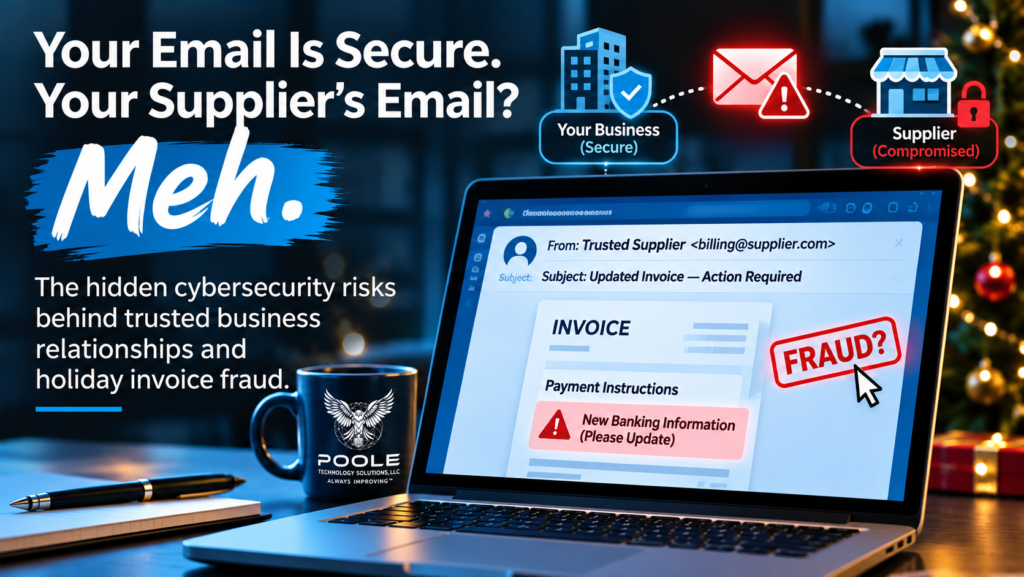
Your business can have the strongest email authentication policies, multifactor authentication, and advanced cybersecurity safeguards in place, yet a single compromised supplier email account can still put your organization at risk.
Let that sink in.
As businesses prepare for the holiday season, increased purchasing, outstanding invoices, seasonal staffing, and year-end financial obligations create a favorable environment for cybercriminals.
But what happens when the suspicious email does not look suspicious at all?
What if it comes from a vendor you have worked with for ten years? What if it contains their actual email address, company logo, a legitimate invoice number, and a previous conversation between your organizations?
Would your employees recognize the threat?
Cybercriminals increasingly understand that compromising trust can be just as effective as compromising technology. Your organization may have strong cybersecurity safeguards in place, but the businesses you depend on could unknowingly introduce risk into your environment.
The Growing Threat of Business Email Compromise
Business Email Compromise (BEC) is a form of cybercrime in which attackers impersonate trusted individuals or compromise legitimate email accounts to facilitate financial theft, obtain sensitive information, or gain unauthorized access to business systems.
According to the FBI’s 2025 Internet Crime Report, reported losses associated with Business Email Compromise exceeded $3 billion.
Microsoft’s November 2026 email threat landscape report also revealed concerning trends:
- Approximately 6.2 million business contact impersonation attacks were observed during the third quarter of 2026.
- Fraudulent invoice payment requests increased by 89% in September compared with August.
- Invoice payment lures more than tripled between June and September.
Although overall business contact impersonation activity declined during the quarter, the increase in invoice-related attacks demonstrates why financial transactions deserve particular attention heading into the holiday season.
Cybercriminals are not simply sending random phishing emails. They are increasingly targeting the business processes organizations rely on every day.
Your Supplier Could Be the Weakest Link
Imagine that your business regularly purchases equipment, inventory, or professional services from a trusted supplier.
Unknown to you, that supplier has experienced an email account compromise.
A cybercriminal gains access to the supplier’s mailbox and begins monitoring conversations between the supplier and its customers. The attacker learns about outstanding invoices, payment schedules, business relationships, and the employees responsible for processing payments.
Then, at the appropriate moment, an email arrives in your inbox.
The message reads:
“Good afternoon. We recently updated our banking information. Please use the attached revised invoice to process your outstanding payment before the holiday break.”
The email address is correct. The invoice amount is accurate. The conversation history is legitimate.
Nothing immediately appears out of place.
Your accounting department processes a $25,000 payment, believing it is fulfilling an existing financial obligation.
Days later, the actual supplier contacts your organization asking why the invoice has not been paid.
Unfortunately, the money has already been transferred to a bank account controlled by cybercriminals.
Your organization could now face a financial loss while still owing the original supplier.
The initial compromise did not even occur within your organization.
Why Email Authentication Alone Is Not Enough
Email authentication technologies such as SPF, DKIM, and DMARC remain essential components of a strong cybersecurity strategy.
These technologies help prevent unauthorized parties from impersonating your organization’s email domain and protect the reputation of your business.
However, there is an important distinction between authenticating an email and determining whether the email is trustworthy.
When cybercriminals gain access to a legitimate email account, messages sent through the organization’s authorized email infrastructure may successfully pass SPF, DKIM, and DMARC authentication checks.
The email may be technically authentic while its intent is malicious.
This exposes an important limitation of relying exclusively on email authentication.
Organizations must implement multiple layers of protection, including advanced threat detection, identity security, employee awareness, third-party risk management, and financial verification procedures.
A legitimate email address does not guarantee a legitimate request.
Why the Holiday Season Creates Additional Risk
The holiday season introduces several operational challenges that cybercriminals are positioned to exploit:
- Increased invoice and payment volumes.
- Employees taking vacations or working remotely.
- Temporary and seasonal employees unfamiliar with established procedures.
- Pressure to complete financial transactions before year-end.
- Increased communication with suppliers, shipping companies, and service providers.
- Reduced oversight when key decision-makers are unavailable.
- Holiday promotions, delivery notifications, and fraudulent payment requests.
A request that might normally receive additional scrutiny can easily be overlooked when employees are overwhelmed or attempting to meet financial deadlines.
Cybercriminals understand that urgency, distraction, and familiarity are powerful tools for manipulating human behavior.
Artificial Intelligence Is Making These Attacks More Convincing
Generative artificial intelligence is further changing the cybersecurity landscape.
Attackers can leverage AI to produce professional communications, imitate writing styles, create convincing invoices, and construct fabricated conversations that appear consistent with normal business activities.
In September 2026, Microsoft reported on a campaign involving more than one million fraudulent emails that exhibited indicators of AI-assisted content creation.
The campaign attempted to persuade accounts payable personnel to process fraudulent payments approaching $50,000 by combining executive impersonation, fabricated invoices, and misleading email conversations.
Traditional phishing indicators, such as spelling mistakes and poor grammar, are no longer reliable ways to identify malicious communications.
Business owners must prepare their employees for a threat landscape in which fraudulent communications can appear just as professional as legitimate business correspondence.
Seven Cybersecurity Best Practices Every Business Should Implement
1. Independently verify changes to banking information
Never authorize a change to a supplier’s payment information based solely on an email request.
Contact the supplier using a previously verified telephone number or an established communication channel. Do not rely on contact information provided in the email requesting the change.
2. Implement dual approval for financial transactions
Require independent approval for significant payments, wire transfers, and changes to vendor banking information.
Where staffing permits, separate the individuals responsible for updating payment information from those responsible for releasing payments.
3. Strengthen email security and authentication
Implement SPF, DKIM, and enforceable DMARC policies to reduce unauthorized domain impersonation.
Combine these controls with email security solutions capable of identifying account compromise indicators, suspicious communication patterns, malicious attachments, and phishing attempts.
Regularly review email allowlists and security exceptions that could undermine these protections.
4. Secure business accounts with multifactor authentication
Require multifactor authentication across business email, accounting platforms, cloud services, and other critical applications.
Prioritize phishing-resistant authentication methods, such as passkeys and hardware security keys, especially for administrators, executives, and employees responsible for financial transactions.
5. Evaluate the cybersecurity posture of your vendors
Your cybersecurity strategy should extend beyond the boundaries of your organization.
Establish minimum cybersecurity expectations for suppliers and business partners. Evaluate their account protection practices, incident notification procedures, and handling of sensitive information.
Prioritize vendors with access to financial information, customer records, or critical business systems.
6. Train employees to recognize business email compromise
Security awareness training must go beyond identifying suspicious links and misspelled email addresses.
Employees should understand how attackers exploit legitimate email accounts, existing conversations, financial urgency, and established business relationships.
Regular phishing simulations and realistic invoice fraud exercises can help reinforce these practices.
7. Establish an incident response plan
Every organization should know what to do when a fraudulent transaction or compromised email account is discovered.
If funds have been transferred, immediately contact your financial institution and request assistance with recovering or recalling the payment.
Notify the appropriate internal personnel, preserve relevant emails and transaction records, contact the affected supplier through a verified channel, and report the incident to the FBI’s Internet Crime Complaint Center at https://www.ic3.gov/.
When an internal account is compromised, promptly contain the account, revoke active sessions, and investigate unauthorized access and mailbox rules.
Time is critical when responding to financial fraud.
Cybersecurity Is Also a Financial Risk Management Strategy
A successful business email compromise attack can have consequences that extend far beyond the initial financial loss.
Organizations may experience:
- Disrupted business operations and cash flow.
- Outstanding financial obligations to legitimate suppliers.
- Reputational damage and loss of customer confidence.
- Legal and regulatory exposure.
- Incident investigation and recovery expenses.
- Cyber insurance coverage disputes or limitations.
Business owners should understand whether their cyber insurance policies cover social engineering fraud, fraudulent funds transfers, and incidents originating from compromised third-party accounts.
Coverage varies, and maintaining documented security controls may help organizations demonstrate compliance with applicable policy requirements.
Cybersecurity should not be viewed exclusively as an information technology expense. It is an investment in financial stability, operational resilience, and business continuity.
How Poole Technology Solutions Can Help
At Poole Technology Solutions, LLC, we understand that small and midsize businesses face many of the same cybersecurity threats as large enterprises, often without the same resources or dedicated security personnel.
Our objective is to help organizations identify their vulnerabilities, understand their business risks, and implement practical safeguards that align with their operational and financial needs.
Our cybersecurity consulting services include:
- Cybersecurity risk assessments: Identify weaknesses across your technology, business processes, and third-party relationships.
- Email security and authentication: Strengthen email protection through SPF, DKIM, DMARC, and advanced threat prevention strategies.
- Third-party risk management: Evaluate security risks introduced by suppliers, vendors, and external service providers.
- Business email compromise prevention: Identify gaps in identity protection, payment verification, and financial security procedures.
- Security awareness and phishing simulations: Prepare employees to recognize and respond to increasingly sophisticated cyber threats.
- AI governance and risk management: Help organizations adopt artificial intelligence responsibly while managing emerging security and privacy risks.
- Cyber insurance readiness: Identify and address security gaps that could affect insurability or compliance with policy requirements.
- Incident response planning: Help businesses prepare for cybersecurity incidents before they occur.
Our approach connects cybersecurity safeguards to real business outcomes: protecting revenue, preserving customer confidence, reducing financial exposure, and maintaining operational continuity.
How Secure Is Your Business Today?
Before investing in additional cybersecurity solutions, it is important to understand where your organization currently stands.
Poole Technology Solutions offers a FREE Cybersecurity & AI Readiness Assessment designed to provide business owners with an initial snapshot of their cybersecurity posture.
The assessment helps identify:
- Existing cybersecurity strengths.
- Potential security gaps and areas of exposure.
- Opportunities to improve cybersecurity governance.
- Artificial intelligence security and governance considerations.
- Prioritized recommendations for strengthening your organization.
Whether you operate a retail business, healthcare practice, professional services firm, nonprofit organization, or growing enterprise, understanding your exposure is the first step toward reducing it.
Take the FREE Cybersecurity & AI Readiness Assessment today:
Conclusion: Trust Is Not a Security Control
The cybersecurity landscape continues to evolve, and cybercriminals are increasingly exploiting the relationships, technologies, and business processes organizations depend on.
Protecting your own infrastructure is essential, but it is only part of the equation.
This holiday season, take the opportunity to review your organization’s cybersecurity safeguards, vendor relationships, financial approval procedures, and employee security awareness.
Do not allow a trusted email address to become an unverified financial instruction.
The most expensive invoice your business receives this holiday season may be the one your supplier never sent.
Be proactive. Reduce your risk. Protect your business.
Poole Technology Solutions, LLC
Website: https://pooletechsol.com/
Email: info@pooletechsol.com
Free Cybersecurity & AI Readiness Assessment: https://assessment.pooletechsol.com/